



Building dependable AI methods requires greater than choosing a strong mannequin. Reliable AI methods are AI functions that produce constant, correct, and reliable outcomes whereas dealing with uncertainty, altering information, and potential failure circumstances appropriately.
Applied information science is the sensible use of information evaluation, statistical evaluation, machine studying, and associated strategies to unravel real-world issues and help data-driven selections.
In AI improvement, it helps professionals put together information, establish patterns, construct fashions, consider efficiency, and enhance system outcomes.
The significance of this basis is changing into clearer as organizations scale AI. McKinsey’s 2026 research discovered that greater than two-thirds of high-performing firms establish information as the first impediment to scaling AI.
A sensible AI reliability lifecycle may be seen as:
Data → Analysis → Model Development → Evaluation → Monitoring → Improvement
For instance, an organization growing an AI mannequin to foretell buyer churn might have a technically sturdy mannequin however nonetheless produce unreliable predictions if buyer information are incomplete, outdated, or poorly represented.
Applied information science helps establish these points and consider whether or not the mannequin performs reliably throughout related buyer teams.
Why Data Science Matters for Reliable AI Systems
The function of information science in constructing AI methods begins with understanding the information used for coaching, testing, and analysis. Poor-quality, incomplete, outdated, or biased information can introduce errors that have an effect on mannequin efficiency, even when the underlying algorithm is technically sound.
Applied information science helps professionals look at datasets, establish patterns, deal with inconsistencies, and decide whether or not the accessible information is appropriate for the issue. Statistical reasoning additionally helps distinguish significant patterns from noise and perceive uncertainty in outcomes.
This turns into particularly essential as organizations transfer AI initiatives towards manufacturing. Informatica’s 2026 research discovered that 57% of information leaders recognized information reliability as a key barrier to shifting AI initiatives from pilots to manufacturing.
For instance, if an AI system is educated to forecast product demand utilizing inconsistent historic gross sales information, its predictions might seem correct throughout testing however carry out poorly when deployed. Data science helps uncover such issues earlier than they have an effect on enterprise selections.
Therefore, information science will not be merely a step earlier than mannequin improvement. It gives the strategies wanted to perceive information, consider proof, and construct extra dependable AI methods.
How Data Quality Affects AI Reliability
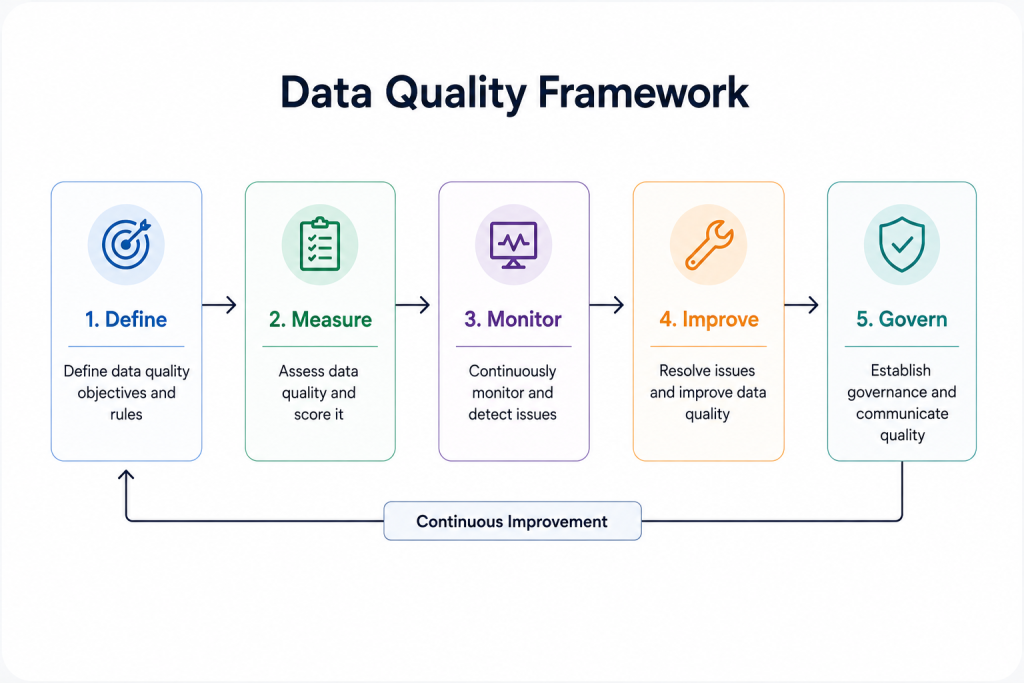
Data high quality instantly influences how an AI system performs. Factors comparable to accuracy, completeness, consistency, timeliness, and equity decide whether or not AI fashions produce reliable outcomes.
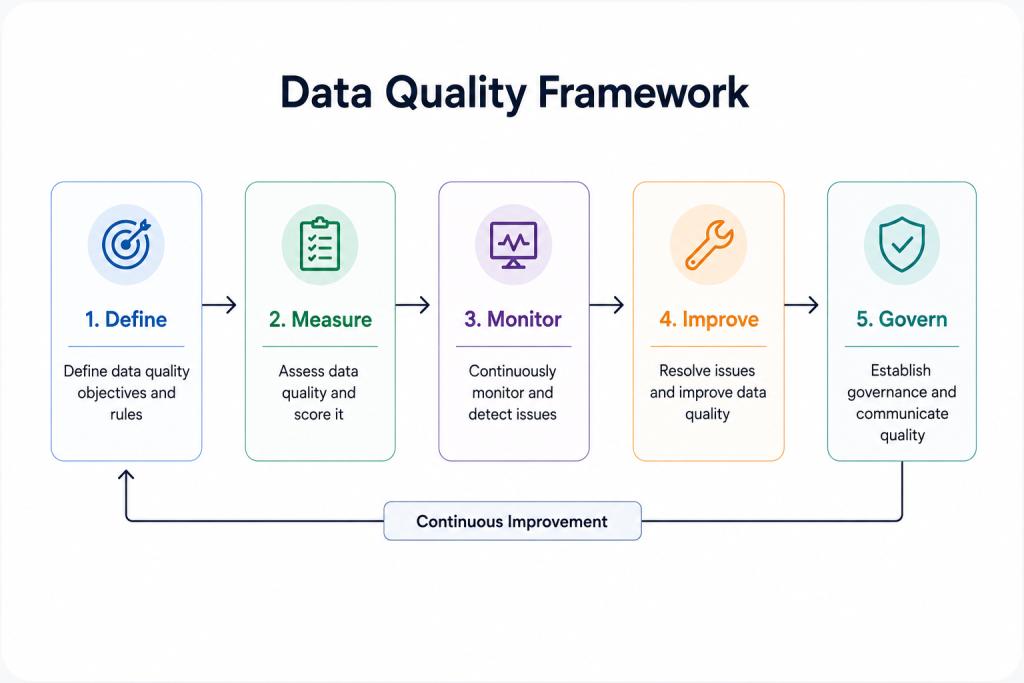
Missing values, outliers, inconsistent information, outdated data, and biased datasets can introduce errors that have an effect on predictions and downstream selections.
Applied information science helps deal with these points by way of information exploration, cleansing, validation, and transformation.
Professionals can establish uncommon observations, look at lacking data, and assess whether or not the dataset represents the issue and customers the AI system is meant to serve.
The problem turns into higher when AI methods rely on real-time or constantly altering information.
Confluent’s 2026 Data Streaming Report discovered that 66% of world IT leaders recognized uncertainty round information lineage, timeliness, and information high quality as a problem when scaling AI.
Data preparation ought to subsequently be handled as an ongoing half of AI improvement fairly than a one-time preliminary process.
Reliable inputs present a stronger basis for dependable outputs, serving to groups construct AI methods which are extra constant and appropriate for real-world use.
How Applied Data Science Helps Build and Evaluate AI Models
Applied information science helps professionals transfer from ready information to fashions that may be examined and improved.
Exploratory information evaluation can reveal essential patterns, whereas characteristic choice and preparation assist decide which data ought to contribute to a mannequin.
Machine studying strategies can then be utilized primarily based on the issue and accessible information. Developing a mannequin is just one stage of constructing a dependable AI system.
Evaluation helps decide whether or not the mannequin performs constantly when utilized to new and unseen information. Professionals additionally want to judge how effectively it performs on information it has not seen earlier than.
Techniques comparable to cross-validation, error evaluation, and acceptable efficiency metrics can assist establish overfitting and different weaknesses.
For classification issues, precision, recall, and F1-score could also be helpful, whereas regression duties can use metrics comparable to MAE or RMSE.
For instance, a mannequin predicting buyer churn might present excessive total accuracy however carry out poorly for a smaller buyer section. Analyzing errors and evaluating efficiency throughout related teams can reveal this limitation.
This course of helps reply a important query: does the mannequin carry out reliably past the information used to develop it?
Why Statistical Reasoning Is Essential for Reliable AI Decisions
Statistical reasoning helps professionals decide whether or not patterns in information signify significant alerts and perceive the uncertainty behind AI-generated outcomes. This helps groups assess how a lot confidence they need to place in AI predictions earlier than utilizing them for selections.
This issues as a result of a mannequin can produce a prediction with out that prediction being equally dependable in each scenario.
Techniques comparable to speculation testing, confidence intervals, correlation evaluation, and statistical validation can present extra context when analyzing information and evaluating mannequin habits.
For instance, a enterprise might observe that clients who obtain a specific provide have increased conversion charges. Statistical evaluation helps decide whether or not the distinction is linked to the provide itself or whether or not different components, comparable to buyer segments or seasonal modifications, influenced the end result.
Statistical evaluation can assist decide whether or not the noticed distinction represents a significant relationship or may merely be the end result of random variation.
Statistical reasoning can even assist professionals examine fashions and assess whether or not modifications in efficiency are significant. This helps higher selections about mannequin choice, testing, and deployment.
Ultimately, how statistical evaluation helps AI goes past calculating numbers. It helps professionals perceive what the proof reveals, how a lot uncertainty exists, and the way confidently an AI end result must be used for decision-making.
How Applied Data Science Supports Modern AI Systems
Applied information science continues to play a key function as AI expands past conventional machine studying into deep studying, advice methods, forecasting, Generative AI, Retrieval-Augmented Generation (RAG), and Agentic AI.
Across these functions, information science helps information preparation, sample discovery, analysis, and steady enchancment.
For instance, a advice system can analyze buyer habits to personalize product solutions, whereas forecasting fashions can use historic gross sales information to estimate future demand.
A RAG software is dependent upon related and dependable data sources to generate grounded responses, whereas an Agentic AI system might use enterprise information to find out which instruments or actions are acceptable.
These functions nonetheless rely on information for coaching, retrieval, analysis, and steady enchancment.
Data science helps professionals put together related datasets, establish patterns, measure efficiency, and consider whether or not outputs meet the necessities of a specific software.
This turns into more and more essential as AI strikes towards real-time functions. Confluent’s 2026 research found that 72% of world IT leaders say inadequate real-time information infrastructure is stalling their efforts to scale AI.
As methods grow to be extra autonomous, information science helps keep the connection between information, system habits, analysis, and real-world outcomes.
How Professionals Can Evaluate AI Systems for Reliability
Evaluating AI reliability requires greater than checking whether or not a mannequin produces correct outputs. Professionals additionally want to grasp how the system behaves with unseen information, sudden inputs, edge circumstances, and altering circumstances.
AI analysis can embody accuracy, robustness, bias evaluation, equity checks, explainability, and failure evaluation.
Accuracy measures how effectively the system performs, robustness checks the way it handles sudden circumstances, equity checks establish unequal outcomes, explainability helps perceive AI selections, and failure evaluation reveals the place methods want enchancment.
Trust can also be an essential half of reliability. Continuous analysis can assist establish modifications in efficiency, rising failure patterns, or shifts in underlying information.
Teams can then examine these points and decide whether or not the mannequin or system wants adjustment.
The objective is to determine a steady cycle of testing, monitoring, evaluation, and enchancment, serving to professionals decide not solely whether or not an AI system works, however whether or not it stays dependable as circumstances change.
How the MIT Professional Education Applied AI and Data Science Program Builds These Skills
The AI and Data Science course by MIT Professional Education combines information science foundations with trendy AI ideas, serving to professionals develop expertise throughout the AI improvement lifecycle.
The curriculum covers statistical evaluation, information high quality, machine studying, deep studying, advice methods, Generative AI, and Agentic AI. It additionally introduces analysis approaches and metrics for assessing AI system efficiency.
Through real-world case research, initiatives, and a capstone, professionals can apply these ideas to sensible issues fairly than studying them solely as theoretical ideas.
The program additionally covers analysis strategies for contemporary AI functions, together with measures comparable to instrument accuracy, ROUGE, BERTScore, and LLM-as-a-Judge. This gives publicity to totally different approaches for assessing AI outputs primarily based on particular functions and use circumstances.
This program is designed for professionals seeking to construct sturdy experience in Data Science, Machine Learning, trendy AI functions, Agentic AI, and AI analysis strategies, enabling them to use AI successfully to real-world enterprise and technical challenges.
Overall, this system connects information science, mannequin improvement, AI analysis, and trendy AI functions, offering professionals with a broader basis for constructing and assessing dependable AI methods.
Final Thoughts
Reliable AI doesn’t start with the mannequin. It begins with understanding the information, making use of sound statistical reasoning, evaluating mannequin efficiency, and constantly monitoring the system.
Applied information science brings these practices collectively, serving to professionals establish information issues, construct acceptable fashions, measure uncertainty, and consider AI methods towards real-world necessities.
The AI and Data Science course by MIT Professional Education can assist professionals develop these capabilities by way of its protection of information science, machine studying, deep studying, Generative AI, Agentic AI, and AI analysis.
Ultimately, utilizing information science to construct dependable AI means making a steady course of of:
Data evaluation → Model improvement → Evaluation → Monitoring → Improvement
Frequently Asked Questions
1. What is utilized information science in AI?
Applied information science includes utilizing information evaluation, statistics, machine studying, and associated methods to unravel sensible issues. In AI, it helps professionals put together information, construct fashions, consider outcomes, and enhance system efficiency.
2. How does information science enhance AI reliability?
Data science improves AI reliability by addressing information high quality, mannequin efficiency, statistical uncertainty, and analysis. These practices assist establish issues earlier than and after an AI system is deployed.
3. Why is information high quality essential for AI methods?
AI fashions be taught from information, so lacking, inconsistent, outdated, or biased information can have an effect on their outputs. Preparing and validating information gives a stronger basis for dependable AI methods.
4. How does statistical evaluation help AI?
Statistical evaluation helps professionals perceive patterns, uncertainty, variation, and relationships in information. Techniques comparable to speculation testing and confidence intervals can present extra context when evaluating AI outcomes.
5. How can AI fashions be evaluated for reliability?
Models may be evaluated utilizing acceptable efficiency metrics, cross-validation, error evaluation, robustness testing, bias evaluation, and unseen information. Continuous monitoring can even establish efficiency modifications after deployment.
6. What expertise are wanted to construct dependable AI methods?
Professionals can profit from expertise in information preparation, statistical evaluation, machine studying, mannequin analysis, information high quality, AI analysis, and monitoring. Knowledge of Generative AI and Agentic AI can even assist when working with trendy AI methods.
7. Which AI and Data Science course can assist professionals construct these expertise?
The AI and Data Science course by MIT Professional Education covers information science and statistical foundations, machine studying, deep studying, Generative AI, Agentic AI, and AI analysis. It additionally contains sensible initiatives and a capstone centered on making use of these ideas to real-world issues.
8. What makes an AI system dependable?
A dependable AI system produces constant and reliable outputs throughout totally different circumstances. Reliability is dependent upon components comparable to information high quality, mannequin analysis, monitoring, equity, explainability, and steady enchancment.
9. How does information science help Generative AI methods?
Data science helps Generative AI by making ready high quality information, evaluating generated outputs, measuring efficiency, and enhancing system reliability. These practices assist guarantee AI responses are related, correct, and helpful.
