

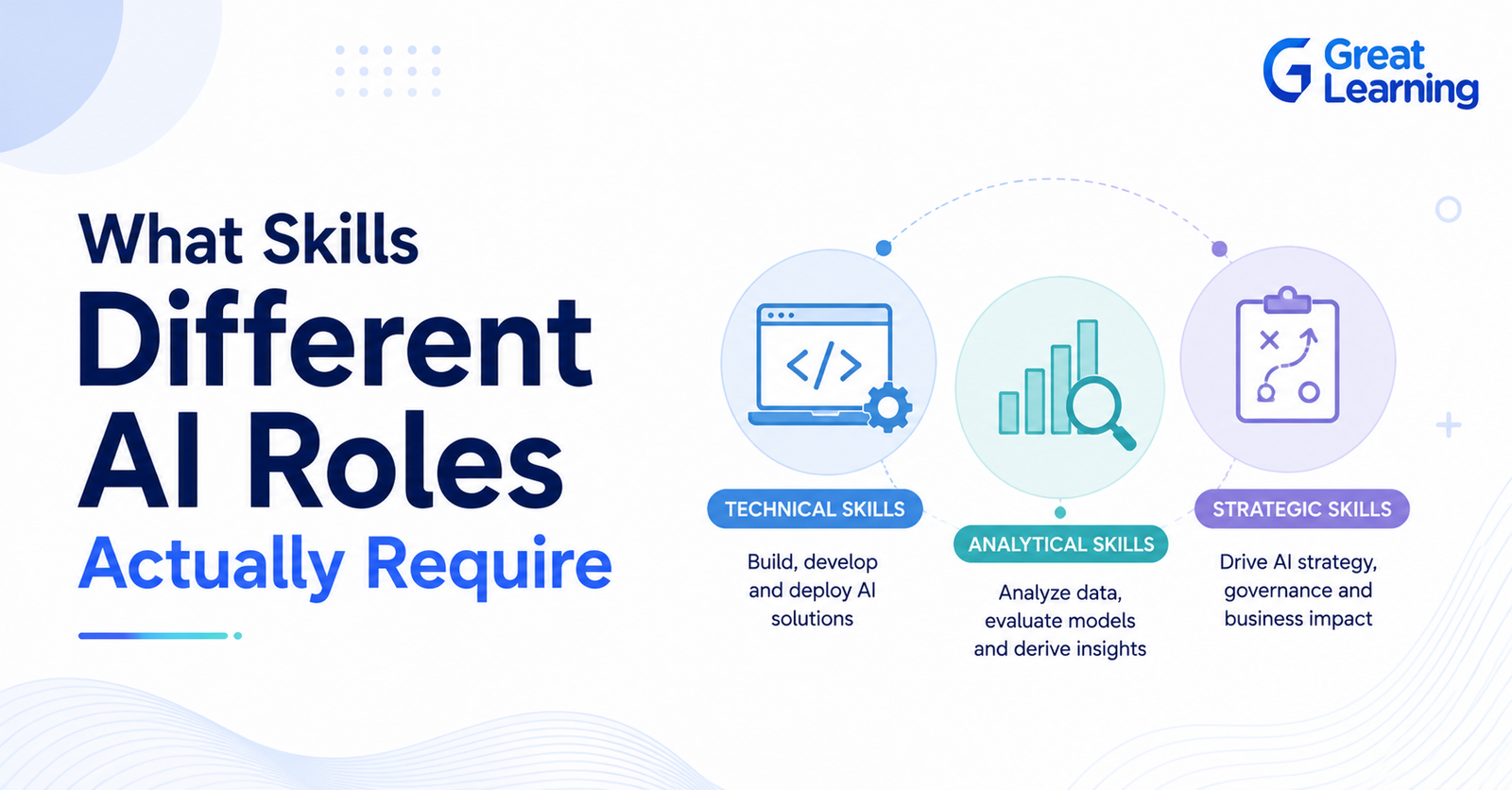
AI expertise fall into three broad classes: technical (programming, mannequin constructing, deployment), analytical (knowledge interpretation, analysis), and strategic (adoption, governance, enterprise decision-making).
Which class issues most to you relies upon fully in your position, this information breaks down the precise expertise for engineers, analysts, product managers, entrepreneurs, and enterprise leaders.
An AI engineer might have programming, machine studying, and mannequin deployment expertise, whereas a enterprise chief might have to perceive AI technique, governance, and enterprise impression.
Similarly, analysts and advertising professionals might profit extra from AI-assisted analytics, Generative AI, and automation.
This makes it necessary to perceive which AI expertise matter for every position, fairly than making an attempt to study each obtainable AI expertise.
The proper strategy, due to this fact, is to join AI expertise with precise job tasks and construct the technical, analytical, or strategic capabilities wanted to apply AI successfully.
Why AI Skills Differ Across Roles
AI is now not restricted to professionals who construct machine studying fashions. Organizations are utilizing it throughout software program improvement, knowledge evaluation, buyer analysis, advertising, product improvement, operations, and strategic decision-making.
As a end result, AI expertise for completely different roles range relying on what professionals are anticipated to accomplish. An engineer might have to construct and deploy an AI system, whereas a product supervisor might have to consider whether or not that system solves a real buyer drawback.
The 2026 PwC Global AI Jobs Barometer, which analyzed a couple of billion job postings throughout six continents, discovered that the talents required for probably the most AI-exposed jobs are altering greater than twice as quick as these required for the least AI-exposed roles.
This exhibits why AI studying wants to be role-specific. Professionals want to develop the technical, analytical, or strategic AI expertise that match how they really use AI in their work.
AI expertise can broadly fall into three classes:
- Technical AI expertise: Programming, machine studying, deep studying, mannequin improvement, and deployment.
- Analytical AI expertise: Data evaluation, statistics, interpretation, analysis, and problem-solving.
- Strategic AI expertise: AI adoption, product technique, governance, danger administration, and enterprise decision-making.
Understanding these variations helps professionals focus their studying on the talents which might be most related to their careers.
What Skills Do AI Engineers Need?
AI engineers want a robust mixture of software program engineering and AI experience as a result of their work usually includes turning AI capabilities into usable functions and programs.
The position can embody constructing AI-powered functions, integrating fashions with APIs and instruments, evaluating outputs, and supporting deployment.
Key expertise embody:
The emphasis is on having the ability to construct, combine, consider, and deploy AI programs, fairly than merely understanding how AI fashions work.
Current 2026 position analyses additionally distinguish AI engineering from knowledge science by putting larger emphasis on manufacturing programs, LLM integration, and system-level implementation.
What Skills Do Data Scientists and Machine Learning Engineers Need?
Data scientists and machine studying engineers typically work with comparable applied sciences, however their tasks are completely different.
Data scientists usually focus extra on understanding knowledge, discovering patterns, constructing fashions, and translating outcomes into enterprise insights, whereas machine studying engineers focus extra on turning fashions into dependable manufacturing programs.
Data Scientists
Data scientists usually want:
Their position is usually to translate a enterprise drawback into an analytical or modeling drawback and decide what the information can reveal.
Machine Learning Engineers
Machine studying engineers usually want:
- Machine studying algorithms
- Deep studying
- Python and software program engineering
- Model optimization
- Deployment
- MLOps
- Cloud and infrastructure
- Model monitoring
The distinction may be summarized merely:
Data Scientist → Data, evaluation, modeling, and insights
ML Engineer → Productionizing, deploying, and scaling ML programs
This distinction issues when selecting which AI expertise to develop. Knowledgeable in statistical evaluation and enterprise problem-solving might have a distinct studying path from somebody who desires to construct and keep manufacturing ML programs.
What AI Skills Do Data and Business Analysts Need?
Data and enterprise analysts don’t essentially want to construct complicated AI fashions. Their focus is extra typically on utilizing knowledge, AI instruments, and analytical strategies to reply enterprise questions and help higher selections.
Important expertise embody:
- Data evaluation and visualization
- SQL and Python fundamentals
- Statistical reasoning
- Generative AI and prompting
- AI-assisted analytics
- Predictive analytics
- Interpreting AI-generated insights
- Identifying helpful AI functions
- Communicating findings to stakeholders
- Understanding AI limitations and potential errors
For instance, an analyst might use Generative AI to discover a dataset, determine potential traits, or pace up reporting, however nonetheless wants the analytical judgment to confirm whether or not the result’s correct and significant.
InterviewStack’s recent 2026 job-posting analysis additionally exhibits this shift. An evaluation of three,891 knowledge analyst postings discovered that 18.7% talked about some type of AI, whereas 6.9% explicitly required newer AI expertise reminiscent of Generative AI, LLMs, or AI brokers.
The key ability is due to this fact not merely figuring out how to use an AI instrument. Analysts want to perceive how to mix AI with knowledge, validate its outputs, and translate the outcomes into actionable enterprise insights.
What AI Skills Do Product Managers Need?
Product managers want sufficient AI information to decide the place AI can create worth, what’s technically possible, and the way an AI-powered product must be evaluated.
They don’t essentially want to construct fashions themselves, however they want sufficient technical understanding to work successfully with engineering and knowledge groups.
Important expertise embody:
- AI and machine studying fundamentals
- Identifying sensible AI use circumstances
- AI product technique
- Understanding mannequin capabilities and limitations
- Evaluating AI outputs and consumer expertise
- Working with knowledge and AI groups
- Responsible AI and governance
- Measuring product and enterprise impression
For instance, a product supervisor growing an AI-powered customer-support function wants to perceive not solely how the system works, but additionally whether or not its responses are correct, helpful, secure, and aligned with buyer wants.
This is turning into an necessary shift in the product position. Productboard’s 2026 research discovered that 96% of product groups use AI persistently, whereas 53% of product professionals recognized systems-level considering as an important ability in the AI period.
The objective is due to this fact not to flip each product supervisor into an AI engineer. It is to develop sufficient AI product information, technical judgment, and analysis expertise to make knowledgeable selections all through the product lifecycle.
What AI Skills Do Business Leaders Need?
Business leaders want a distinct mixture of AI expertise from technical specialists. Their focus is much less on constructing fashions and extra on understanding AI alternatives, evaluating dangers, guiding adoption, and connecting AI investments with enterprise outcomes.
Key expertise embody:
- AI fundamentals and literacy
- Identifying high-value AI use circumstances
- AI technique and adoption
- Understanding AI capabilities and limitations
- AI governance and danger administration
- Evaluating AI investments and ROI
- Change administration
- Responsible AI
- Strategic decision-making
For instance, a enterprise chief evaluating an AI customer-service system wants to decide whether or not it may possibly enhance service high quality, what dangers it introduces, the way it must be ruled, and whether or not the anticipated enterprise worth justifies the funding.
This want for leadership-level AI functionality is turning into extra necessary as organizations transfer from experimentation towards broader deployment.
KPMG’s 2026 Global AI Pulse, primarily based on greater than 2,100 senior leaders throughout 20 nations, highlights accountability, governance, AI economics, and visibility into AI prices and outcomes as more and more necessary as organizations scale AI.
The objective is due to this fact not to flip each enterprise chief into an information scientist. It is to develop sufficient AI literacy, strategic judgment, and governance information to make knowledgeable selections about the place AI must be used and the way it must be managed.
What AI Skills Do Marketing Professionals Need?
Marketing professionals more and more want a mix of AI fluency, knowledge expertise, and strategic judgment.
Rather than turning into AI engineers, they want to perceive how AI can enhance analysis, content material creation, personalization, marketing campaign evaluation, and buyer engagement.
Key expertise embody:
- Generative AI and prompting
- AI-assisted buyer and market analysis
- Content and workflow automation
- Marketing analytics and knowledge interpretation
- Personalization
- AI use-case identification
- Quality management and analysis
- Responsible AI and knowledge privateness
- Strategic considering and communication
For advertising professionals, the objective is due to this fact not merely to study extra AI instruments. It is to mix AI fluency with advertising experience and human judgment to enhance enterprise outcomes.
How the Texas McCombs PG Program in AI & ML Builds These Skills
Professionals trying to construct a broader AI ability set can profit from a structured program that mixes technical foundations with sensible enterprise functions.
The Artificial Intelligence course by Texas McCombs covers Python, machine studying, deep studying, NLP, pc imaginative and prescient, Generative AI, Agentic AI, mannequin analysis, and AI deployment.
The program additionally emphasizes hands-on studying by way of initiatives, case research, and 30+ AI instruments, serving to learners apply AI and ML strategies to sensible enterprise issues.
Technical professionals can construct deeper experience in AI and ML, whereas product, expertise, and enterprise professionals can develop the technical understanding wanted to consider and apply AI options.
The program particularly lists product and tech enablement professionals and enterprise leaders amongst its goal learners.
The focus is due to this fact not simply on studying particular person AI instruments. It is on growing sensible AI functionality, technical understanding, and strategic judgment that professionals can apply to real-world issues.
Final Thoughts
AI expertise are now not restricted to professionals who construct machine studying fashions. The proper expertise depend upon the position, tasks, and stage of AI involvement.
AI engineers want technical depth, knowledge scientists want robust analytical and modeling expertise, whereas analysts, product managers, advertising professionals, and enterprise leaders want expertise that assist them apply, consider, and handle AI successfully.
The secret is to give attention to role-relevant capabilities fairly than making an attempt to grasp each AI expertise.
The Artificial Intelligence course by Texas McCombs may help professionals construct a broader basis throughout AI, machine studying, Generative AI, Agentic AI, analysis, and deployment whereas making use of these ideas to sensible enterprise issues.
Ultimately, probably the most worthwhile AI ability set is one which connects technical information with sensible software and sound skilled judgment.
Frequently Asked Questions
1. What AI expertise are most necessary for professionals?
The most necessary AI expertise depend upon the position. Technical professionals might have programming, machine studying, and mannequin deployment, whereas enterprise professionals might profit extra from AI literacy, analytics, Generative AI, analysis, and strategic decision-making.
2. What expertise do AI engineers want?
AI engineers usually want Python, machine studying, deep studying, Generative AI, LLMs, RAG, Agentic AI, APIs, mannequin analysis, deployment, and MLOps expertise.
3. What expertise do knowledge scientists want?
Data scientists usually want statistics, Python, knowledge evaluation, exploratory knowledge evaluation, function engineering, machine studying, predictive modeling, mannequin analysis, and enterprise communication expertise.
4. What AI expertise ought to enterprise analysts study?
Business analysts can profit from knowledge evaluation, statistical reasoning, AI-assisted analytics, Generative AI, prompting, knowledge visualization, and the flexibility to consider and talk AI-generated insights.
5. What AI expertise do enterprise leaders want?
Business leaders want AI literacy, AI technique, use-case identification, governance, danger administration, accountable AI, change administration, and the flexibility to consider AI investments and enterprise impression.
6. What AI expertise do advertising professionals want?
Marketing professionals can profit from Generative AI, prompting, AI-assisted analysis, content material workflows, personalization, advertising analytics, automation, and accountable AI practices.
7. Can non-technical professionals construct AI expertise?
Yes. Non-technical professionals don’t essentially want superior programming or machine studying experience. They can give attention to understanding AI fundamentals, utilizing related AI instruments, evaluating outputs, figuring out helpful functions, and connecting AI capabilities with their skilled tasks.
8. How can professionals construct the fitting AI ability set?
Start by figuring out your goal position and present ability gaps. Then construct the AI fundamentals related to that position, apply by way of real-world initiatives, and develop the flexibility to consider and apply AI successfully.
9. Which AI course may help professionals construct role-relevant AI expertise?
The Artificial Intelligence course by Texas McCombs covers AI and machine studying foundations together with Generative AI, Agentic AI, mannequin analysis, deployment, and different sensible functions. It may help professionals develop a broader understanding of AI and apply these capabilities to real-world enterprise issues.
